Showing posts with label Week 8. Show all posts

Tuesday, 12 November 2019

First Playable

So far I am making good progress with my game. I have finished the forest area of my game which included several collectable gems that make a sound, rotate and disappear when walked over. I have finished the fenced off area in my game which include the same gems but in another color. So far my game is going according to my initial plan and I'm happy with how it's coming along.

Forest Area and Fenced Area.

I have also included a first person playable character. They begin the game in the middle of the four areas and choose themselves where to go first. Each of the four open areas has a gem placed in front of the entrance so the player can choose which path they wish to take. 

A difficulty I have found while designing this is the terrain size. As I did not make the terrain smaller when first creating the atmosphere it is now quite big. While editing I found it is difficult to place objects and create the surroundings with such a massive terrain. However, to solve this problem I have created a smaller terrain and fenced off the area that goes beyond where I want the player to go.

By doing so I have made the area smaller so the player won't get lost and will be able to walk around the area and explore more rather than have a big area of basic assets. I plan to finish the boulder and mountain area and then start on the timer as well as make a start on the night version.

Saturday, 2 November 2019

Unity Free Tutorials

The tutorials I followed were Main Menu Tutorial and Main Menu Tutorial 2 because I have decided to include a main menu screen for my game.  

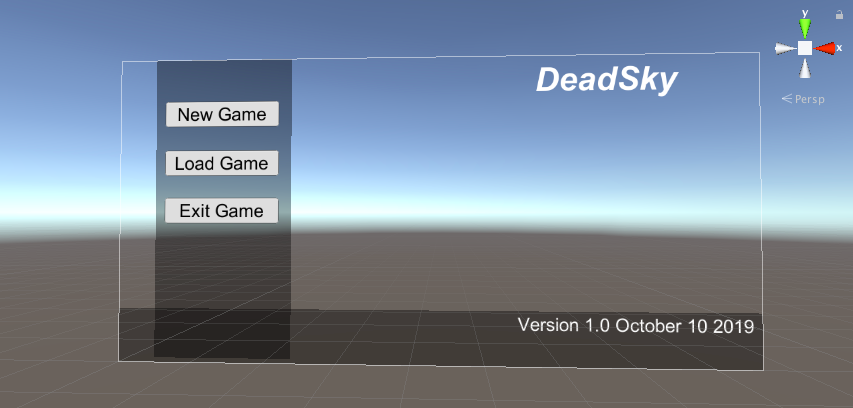
In these two tutorials we learnt how to make a main menu screen for a game. We had to create a new scene in order to make a main menu. The first tutorial was simple, it showed how to include the titles and a side menu.

Simple Main Menu.

In the first tutorial there were some issues with having the button fade in and out when hoovered over. It took a while to get it figured out, which was quite annoying when watching the video as I would have hoped he would film the video but remove scenes such as these as they only take up time and have me follow the mistakes as well. 

However, later on it was shown to be a glitch in Unity itself, this was also very annoying and time consuming. It proved that black was a difficult colour, causing many troublesome problems. This is unfortunate as I did want my game to have black buttons, but I have decided on different colours – #F3F3F3 for the background to replace black and #5C3232 and #952828 for the button clicks.
In the second tutorial we learnt how to make the main menu more advanced, such as adding an animated scene in the background and include a fade in/fade out logo. 

We had to create a new terrain and lay it out as we wished to create the scene we wanted. It incorporated a lot of old tutorials.

More Advanced Main Menu.

Game Fun

The first article I read was “Natural Funativity” by Noah Falstein.

“We may not be able to describe fun, but we know it when we have it.”

He talks about ‘The Natural Funativity Theory’ that says that one of the toughest tasks as a game developer is picking a suitable name, and that stealing (or borrowing) from other sources is one method. This theory is then broken into three areas. 

  1. Physical Fun.
  2. Social Fun.
  3. Mental Fun.
Physical fun is the simplest place to see a connection between our evolutionary heritageand games and entertainment is in this physical arena. Our primary urge is the survival instinct. Anything that involves threats to survival is likely to get a large audience. Some major factors for survival ability in a hunter-gatherer society were strong muscles and good coordination. This is why sports are quite popular in certain cultures. But physical fun doesn’t just apply to the hunting side of hunter-gatherers. In video games, gathering became very popular and RPG’s encouraged players to gather items making them popular games. Exploration is also a popular component to many games. 

Evolution focuses not just on the survival of individuals, but also the issue of reproduction and all the associated matters of meeting and attracting mates. Social interactions is a very part of our lives and this moves onto video games. We play games now are able to play video games while talking to our videos or even strangers. Games also include characters which socialize in the game.

The essence of intelligence is the perception and manipulation of patterns. Game designer Brian Moriarty found that people love to find patterns in things. In history games such as the Rubic’s Cube have proven to show that humans love patterns and enjoy mental fun. 


The second article is “Clubs, Diamonds, Hearts, Spades: Players Who Suit MUDs” by Richard Bartle. In this article four approaches to playing MUDs are identified and described.

The four things that people typically enjoyed about MUDs were:

·     Achievement within the game context.
·     Exploration of the game.
·     Socialising with others.
·     Imposition upon others.

Labelling the four player types we get: achievers, explorers, socialisers and killers. Often players would drift between these four types, depending on their mood when playing. However, most usually have a primary style. 

The “interest graph” is a representational structure which can chart what players find of interest in a MUD.

Interest Graph. (Source)

The axes of the interest graph represent the source of players interest in a MUD. Achievers are interested in doing things in the game, i.e. in acting on the world. Explorers are interested in having the game surprise them. Socialisers are interested in interaction with other players. Killers are interested in doing things to people, i.e. in acting on other players.
A stable MUD can be adjusted so as to favour the various extremes of the interest graph, and what would happen if each approach were taken to the limit: 

  • Players.
  • World.
  • Interacting.
  • Acting.